Vinyl Siding Installation & Replacement in New Jersey
Vinyl siding remains one of the most practical exterior upgrades for New Jersey homeowners - it holds up against the region's coastal humidity, winter freeze-thaw cycles, and summer heat without requiring the upkeep that wood or fiber cement demand. At American Quality Remodeling, we handle the full range of vinyl siding services across NJ: new installation, full replacement, and repairs for existing siding that's showing wear. Whether you're updating a single-family home in Burlington County or replacing damaged panels on a property in Camden County, our crews work with the materials and techniques appropriate for the local housing stock and climate conditions.
Choosing the right vinyl siding product for a New Jersey home depends on the property’s architecture, exposure to wind and moisture, and the homeowner’s goals for energy efficiency and curb appeal. The material has expanded far beyond the basic horizontal lap panels most people associate with vinyl – today’s product lines cover traditional profiles, insulated systems, and architectural-grade options that closely replicate natural materials.
Traditional Vinyl Siding Options
Traditional vinyl siding in New Jersey is typically available in horizontal lap, Dutch lap, beaded seam, and vertical panel profiles. Horizontal lap is the most common choice for residential exteriors in the region – it’s versatile, installs efficiently, and comes in a wide range of colors and finishes. Dutch lap adds a slightly shadowed groove that gives the facade more visual depth, which works well on colonial and ranch-style homes common throughout South Jersey.
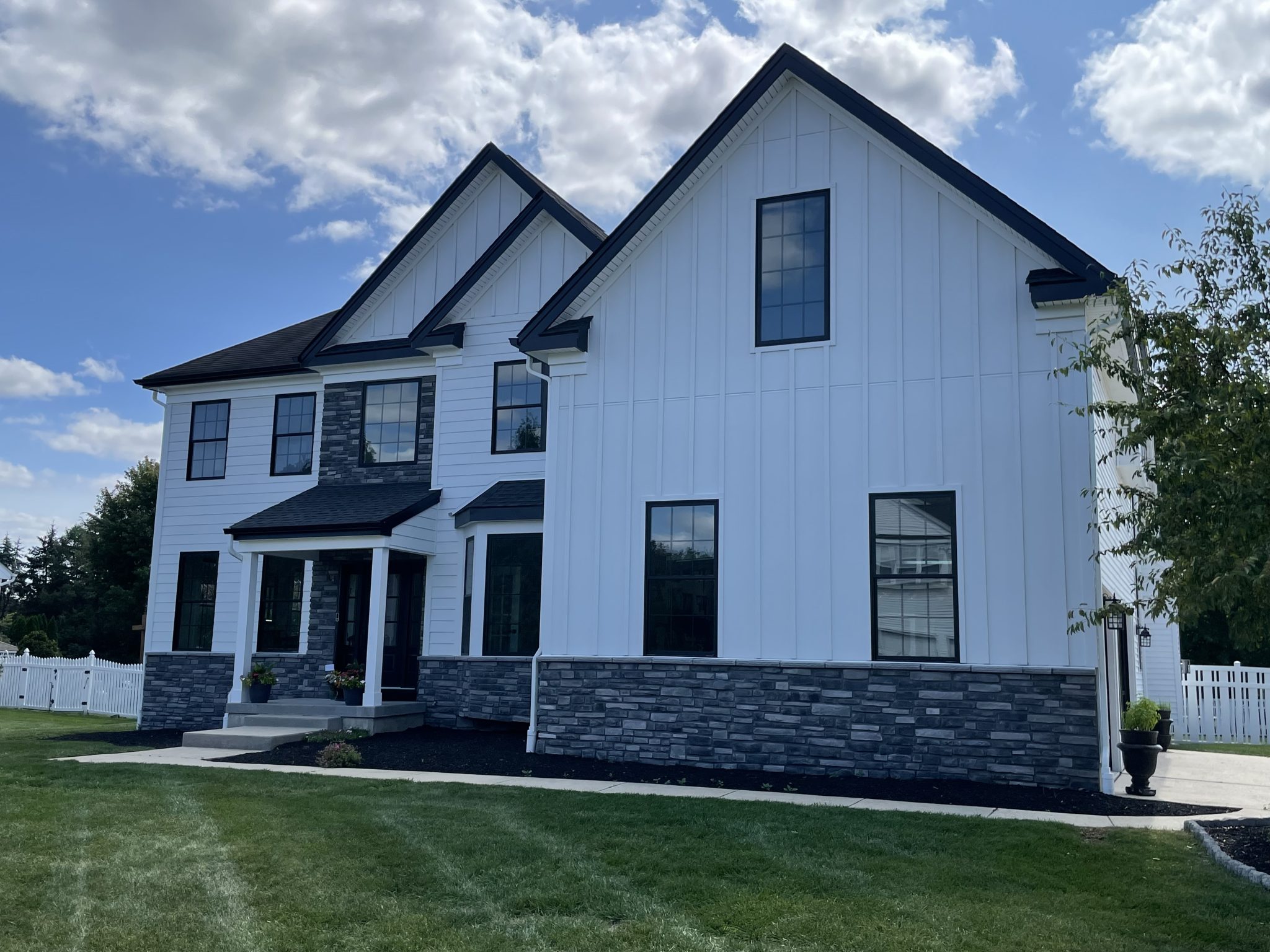
Beaded seam panels introduce a rounded detail at the bottom of each course, a profile originally associated with craftsman and Victorian-era homes. Vertical siding, often installed as board-and-batten or V-groove, works well on accent sections, gable ends, or full facades where a more contemporary or farmhouse aesthetic is the goal.
When it comes to thickness, traditional vinyl panels in New Jersey range from 0.040 to 0.046 inches. Heavier panels dent and flex less under impact – a consideration for homes in areas with frequent hail or storm debris. We select panel weight based on the specific exposure and structural conditions of each project.
Insulated Vinyl Siding
Insulated vinyl siding differs from standard panels in one key way: a layer of contoured foam backing is factory-bonded to the inside face of each panel. That foam fills the hollow void between the siding and sheathing, which reduces thermal bridging and makes the wall assembly more resistant to heat transfer.
For New Jersey homes – where heating bills run high through winter and cooling loads build during humid summers – insulated siding offers a measurable improvement in wall R-value without requiring separate foam board installation. It also adds rigidity to each panel, reducing the hollow sound that standard vinyl can produce when struck, and improving resistance to wind-driven flex.
Insulated vinyl is available across most of the same profiles as standard siding, so homeowners don’t have to sacrifice the look they want to get the performance benefit. It typically costs more per square foot than non-insulated options, but the combination of reduced energy loss and better structural performance makes it a practical upgrade for older homes with minimal wall insulation.
Architectural Grade Vinyl
Architectural grade vinyl siding is manufactured to tighter tolerances, with greater panel thickness, richer color depth, and textures engineered to replicate cedar shake, wood grain, or stone. These products are positioned at the upper end of the vinyl category and are appropriate for homes where aesthetics are a priority alongside performance.
Cedar shake vinyl panels, for example, produce a texture and shadow profile that closely mimics real wood shingle siding – without the moisture absorption, rot risk, or repainting schedule that real cedar demands. This makes them a frequent choice for homes in coastal communities in New Jersey, where salt air and humidity accelerate the deterioration of natural wood products.
Architectural grade panels also carry longer manufacturer warranties and are generally more resistant to fade, impact, and temperature-related warping. For historic neighborhoods or HOA-governed communities where exterior appearance is regulated, these higher-spec products help meet design standards while keeping long-term maintenance obligations low.
Get in touch
to contact us
Vinyl Siding Installation Process in New Jersey
Vinyl siding installation in NJ is a multi-stage process that starts well before the first panel goes up. Rushing preparation steps – or skipping them – leads to common problems down the line: panels that buckle in heat, seams that allow moisture infiltration, and uneven finished surfaces. Our installation process is structured to eliminate those outcomes from the start.
Pre-Installation Inspection
Before any material is ordered or scheduled, we conduct a thorough inspection of the existing exterior. This assessment covers the condition of the wall sheathing, the presence and integrity of housewrap or moisture barrier, the condition of trim boards and corner posts, and any areas of prior water intrusion or rot.
Siding is an exterior envelope component – it only performs as well as the substrate behind it allows. If sheathing is soft, compromised, or missing housewrap in sections, installing new vinyl on top of those problems doesn’t solve them. Our pre-installation inspection identifies what needs to be corrected before siding work begins, so the final installation performs as a complete weather-resistant system.
We also note structural details specific to the property: window and door rough openings, utility penetrations, existing flashing conditions, and the overall plumb and square of the wall framing. These factors affect material layout, trim detailing, and the installation sequence we plan for the project.
Material Selection & Preparation
Once the inspection is complete and any substrate issues are addressed, we finalize the material selection with the homeowner. This includes panel profile, color, texture, thickness, and whether insulated backing is part of the scope. We also specify all accessory components at this stage: starter strips, J-channel, F-channel, utility trim, corner posts, soffit channel, and any specialty trim pieces required by the home’s architectural details.
Accurate material takeoffs prevent mid-project shortages and ensure consistent dye lots across the full installation. Vinyl panels from different production runs can show slight color variation, which becomes visible in direct light – particularly with lighter colors. By ordering complete quantities from the same lot upfront, we avoid that issue entirely.
All materials are staged and inspected before the installation crew begins. Panels are checked for damage, trim lengths are cut to spec, and any custom order components – such as specific corner profiles or matching soffit material – are confirmed against the project plan.
Professional Installation Steps
Vinyl siding installation follows a defined sequence. The starter strip is set first, establishing the level baseline from which every subsequent course is measured. This step determines whether the finished wall will look straight and consistent, so it’s done with care and checked across the full length of each wall before any panels are applied.
Corner posts and J-channel around windows and doors are installed next, creating the perimeter framework into which panels will terminate. Proper channel depth and gap allowance at these transitions is critical – vinyl expands and contracts with temperature, and panels need room to move without buckling or pulling away from trim.
From there, panels are installed course by course from the bottom up, each locking into the one below and nailed with appropriate fastener spacing to allow thermal movement. Nails are driven through the nail slot at the center, not the slot ends – a detail that ensures panels can shift laterally without stress fractures at the fastener point.
Penetrations for outlets, fixtures, hose bibs, and vents are cut to fit and fitted with appropriate trim accessories. Soffit and fascia work, where included in the scope, is completed to tie the full exterior together. At project completion, we do a walk-through with the homeowner to verify alignment, seam consistency, trim fit, and overall finish quality before we close out the job.
Vinyl Siding Repair & Maintenance Services
Not every siding project requires full replacement. Vinyl siding is repairable in many situations, and catching problems early reduces the scope and cost of what’s needed to restore the exterior. American Quality Remodeling handles both repairs and full replacement for New Jersey homeowners, and our assessment process helps identify which approach makes sense for a given situation.
Common Vinyl Siding Problems
New Jersey’s climate creates a specific set of stresses on exterior siding. Temperature swings between summer highs and winter lows cause vinyl to expand and contract repeatedly over its service life. Wind-driven rain during nor’easters and tropical systems tests the integrity of seams and penetration flashings. UV exposure bleaches and brittles older panels over time.
The most common vinyl siding problems we diagnose and repair include:
Cracked or broken panels – typically caused by impact from hail, debris, or accidental strikes; individual panels can often be replaced without disturbing the surrounding installation.
Warped or buckled siding – usually the result of panels installed without adequate expansion allowance, or panels installed too close to heat sources such as grills or HVAC exhaust.
Moisture intrusion behind siding – often traced to failed caulk at penetrations, compromised housewrap seams, or improper flashing at windows and doors; the siding itself may be intact while the problem develops in the wall assembly behind it.
Loose or separated panels – can result from fastener failure, improper nailing during original installation, or storm-force winds that exceed panel lock engagement.
Fading and chalking – a surface-level issue on older installations; in many cases, this signals the approach of end-of-service-life rather than a repair candidate.
Repair vs. Replacement Decision
The decision between vinyl siding repair and full replacement in New Jersey depends on several factors beyond visible damage. Age is a primary consideration – panels manufactured 20 or more years ago may no longer be available as matching replacements, and even if a close match exists, color fade on the existing panels will make patches visually obvious. In those cases, partial repair solves a structural problem but creates an aesthetic one.
The extent of damage is the other major variable. Isolated panel cracks or a few loose sections in an otherwise sound installation are repair candidates. When damage is distributed across multiple elevations, moisture has gotten behind panels in multiple locations, or the underlying sheathing is compromised in several areas, the economics and practicality shift toward replacement.
We provide honest assessments at the inspection stage. If repair is the right answer for the condition and budget, we’ll recommend that. If the installation is at a point where replacement delivers better long-term value, we’ll explain why with specifics rather than a push toward the higher-ticket option.
Maintenance Tips for NJ Climate
Vinyl siding requires less maintenance than wood or fiber cement, but regular attention extends its service life and prevents minor issues from developing into larger problems. For New Jersey homes specifically, where humidity is high and storm seasons are active, the following practices keep siding performing well between major service intervals:
Annual washing – soft-bristle brush or low-pressure rinse removes accumulated dirt, mold, and mildew that degrade surface appearance and can hold moisture against the panel surface; avoid pressure washing directly into seams or upward at panel overlaps.
Post-storm inspection – after significant wind or hail events, walk the perimeter and look for cracked panels, lifted sections, or displaced trim accessories; small impacts that look cosmetic can allow water behind the siding if left unaddressed.
Caulk inspection at penetrations – check around outlets, hose bibs, vents, and light fixtures annually; failing caulk at these points is a common moisture entry path.
Clearance from grade and vegetation – siding should maintain clearance from soil, mulch, and plant material at the base; direct contact holds moisture against the bottom courses and accelerates panel and sheathing deterioration.
Gutter condition – clogged or damaged gutters allow water to overflow against siding at eaves; keeping gutters clear reduces the moisture load on the upper courses of siding near the roofline.
These are straightforward tasks for homeowners, but they make a real difference in how long a vinyl installation holds up in New Jersey’s climate.
Selecting a vinyl siding contractor in New Jersey involves more than comparing price quotes. The quality of an installation depends on the crew’s understanding of the material, their attention to substrate conditions, and the discipline of their process from inspection through final walk-through. These are the areas where our work is distinguishable from lower-bid alternatives.
Licensed & Insured Contractors
American Quality Remodeling operates as a fully licensed and insured contractor in New Jersey and Pennsylvania. Licensing ensures compliance with state contractor requirements and gives homeowners recourse through formal channels if disputes arise. Insurance – both general liability and workers’ compensation – protects the homeowner’s property and eliminates exposure to liability for on-site incidents.
Working with vinyl siding contractors in NJ who carry proper credentials isn’t a formality. It’s a practical protection for the homeowner’s investment. We provide documentation of licensing and insurance coverage as part of the estimate process, before any agreement is signed.
Local Experience in New Jersey
Our crews work specifically in the New Jersey and Pennsylvania market, which means they’re familiar with the housing types, construction vintages, and exterior conditions common to the region. A pre-war colonial in Camden County presents different siding challenges than a 1970s split-level in Burlington County or a coastal cape in Ocean County – substrate conditions, architectural details, and material exposure vary significantly.
That regional experience matters during the inspection and preparation phase, where decisions about substrate repair, housewrap condition, and accessory selection are made. It also matters during installation, where knowledge of local building practices helps crews anticipate what they’ll find behind the existing cladding and plan accordingly.
We’ve completed siding projects across South Jersey, Central Jersey, and into southeastern Pennsylvania – a service footprint that reflects genuine regional experience rather than occasional out-of-area work.
Warranty & Customer Satisfaction
We stand behind the work our vinyl siding installation contractors perform. Installation workmanship is covered under our contractor warranty, which addresses issues arising from the installation process itself – not just material defects. Manufacturer warranties on the vinyl panels we install are passed through to the homeowner and cover product performance according to the terms of each manufacturer’s program.
At project completion, we walk every job with the homeowner before we consider it closed. If something isn’t right – a seam that’s off, a trim detail that needs adjustment, a panel that was marked during installation – it gets corrected before we leave the site. That standard applies across every project, regardless of size.
Our Google rating reflects the consistency of that approach across more than 120 reviewed projects. For homeowners evaluating vinyl siding companies in New Jersey, we’re straightforward about what the work involves, how long it takes, and what the finished result will look like – so there are no surprises at any stage of the project.
Other types of
Siding
Explore our diverse materials for your home's perfect fit.
James Hardie Siding & Window Upgrade In Edgewater Park, NJ
Comprehensive exterior transformation combining premium James Hardie fiber cement siding with energy-efficient windows. Our integrated approach delivers a cohesive design that maximizes both aesthetic impact and functional performance, creating a home that's beautiful, comfortable, and built to last.
James Hardie Siding Installation In Cherry Hill Township, NJ
Complete exterior renewal featuring James Hardie fiber cement siding that delivers lasting beauty and superior protection. Our meticulous installation process ensures your home benefits from industry-leading durability, minimal maintenance requirements, and a fresh, modern appearance that enhances value and curb appeal.
Classic coastal charm meets modern durability with premium James Hardie shake siding. Our expert installation delivers the timeless beauty of traditional wood shakes with the superior performance of fiber cement technology, providing maintenance-free protection that stands up to coastal weather conditions.
Superior roofing installation that combines aesthetic excellence with dependable performance. Our expert team delivers precision craftsmanship and premium materials, ensuring your home receives comprehensive protection while maintaining an elegant appearance that elevates your property's distinction.
Reliable roofing solutions that deliver lasting protection and peace of mind. Our skilled team installs quality roofing systems with meticulous attention to detail, ensuring your home stays safe and dry through every season while enhancing its overall appearance and value.
Complete Exterior Makeover In Lumberton Township, NJ
Full-scale exterior renovation featuring modern board and batten siding, energy-efficient windows, and stylish entry door installation. Our integrated approach ensures every element works harmoniously to create a striking contemporary aesthetic while maximizing protection, efficiency, and functionality for your home.
The longevity of vinyl sidings ranges between 20-40 years or even more depending on the quality and installation process.
It may be easier than its counterparts but it will be better if you allow an expert to do it so that they can guarantee proper installation for maximum protection for your house.
Vinyl sidings do not require any painting because they come in different colors which are baked into them hence maintaining their color without having to repaint them.
Vinyl sidings are very low maintenance, giving them a spray with a garden hose is enough for cleaning using mild detergent. Regular cleaning keeps it looking new and increases its life span.
Yes, one is allowed but only after having professionals assess the condition of the existing structure as well as the previous coating.